The World Has Turned: How a Bumblebee Decides the Day Has Begun
Introduction: The Simple Question with a Surprising Answer
On a cool summer morning, before most of us have started our first cup of tea, something remarkable happens. Inside a bumblebee nest, a single worker bee slips out into the chill air, and with that one act, the colony's workday begins. But what tells her that now is the moment?
This question sounds simple, but the obvious answers are all incorrect. It isn't a specific time on the clock. It isn't when the air reaches a certain temperature, or even when the sun rises. Some cold days, the bees leave early; on warmer days, they might wait. The real answer is far more profound. It reveals that bees are not just living in the world; they have evolved to feel its physical structure in real time.
Following this question uncovers a small journey into how animals interpret the physical world. The signal that starts a bee's day isn't a number or a time, but a fundamental change in the state of the world itself—a moment when the night, in the most literal sense, loosens its grip.
The Takeaways: 5 Surprising Truths from a Bumblebee Colony
They Don't Wait for Warmth; They Wait for the World to Turn
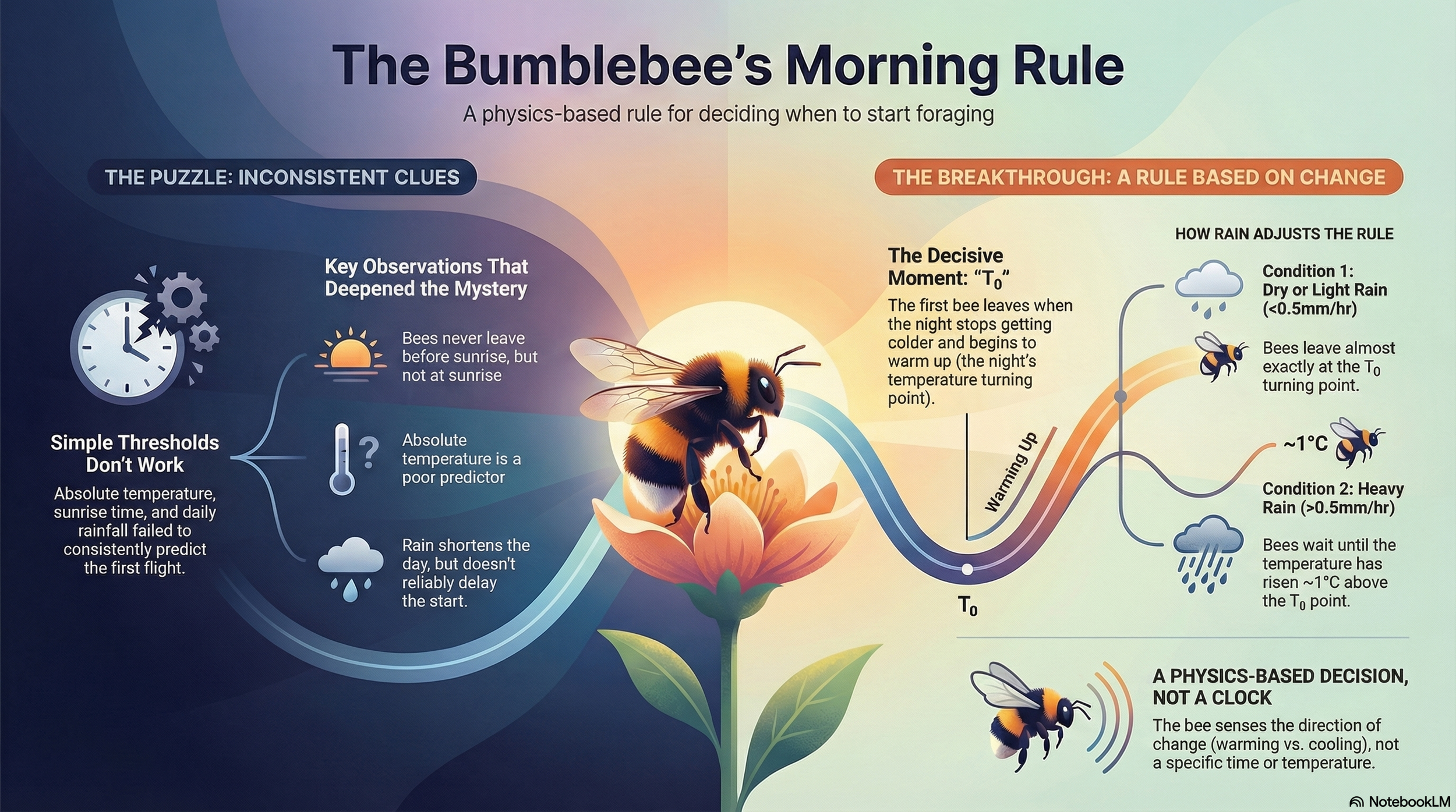
The core discovery is that bumblebees don't begin foraging when the air reaches a certain comfortable temperature. Instead, they leave at the precise moment the night stops getting colder and begins to warm up. This is the coldest point of the night, a thermal turning point I call T₀.
This "bottom of the night" is a reliable signal that conditions are improving. The bee’s departure is not a clock-based decision. It is a physics-based one, tied directly to the thermal dynamics of the morning.
The bees are responding not to how warm it is, but to which direction the world is moving.
Cloudy Nights Make Their Timing More Precise, Not Less
One of the most counter-intuitive findings is how clouds affect the bees' timing. One might expect a cloudy, overcast night to confuse them, but the opposite is true. Clouds act like a blanket, slowing the rate at which heat radiates away from the earth.
This creates a smoother, less "jagged" temperature curve as the night progresses. A smooth, gentle curve makes the exact bottom—the T₀ moment—unmistakably clear, removing the 'noise' of small temperature fluctuations that could create false signals. The paradox is that cloudy nights, rather than obscuring the signal, actually help the bees time their departure with greater accuracy.
Sunrise Is a Gate, Not a Trigger
While bees never leave the nest before sunrise, the rising sun itself does not dictate when they leave. Light is necessary for vision and navigation, but it is not an "instructive" signal that tells the bees to start their day.
Instead, sunrise acts as a gate. It opens the possibility for the day to begin, but it doesn't push the bees through it. They must still wait for the other critical cue—the moment the world stops getting colder. Light opens the door. The temperature trend decides when they step through.
They Care About Rain Right Now, Not a Rainy Day
The way bees react to rain reveals a subtle but critical distinction. The total amount of rain that fell overnight or is predicted for the day does not reliably delay their start. The only thing that matters is whether heavy rain (above approximately 0.5 mm/hour) is falling at the moment of exit.
When it is raining heavily at their preferred departure time, the bees don’t abandon the T₀ rule; they simply adapt it. They add a safety margin, waiting until the temperature has risen about 1°C above the nightly minimum before they venture out. They aren't predicting a bad day; they are reacting to a bad moment.
The bees do not forecast. They probe.
They're Waiting for Viability, Not Comfort
The "why" behind this behavior is about survival and efficiency. For a bumblebee, cooling air is a profound threat. Flight muscles lose their power. The energy required for flight skyrockets. And a forced landing on cold, damp ground can be a death sentence.
Warming air, even if it is still objectively cold, signals improving conditions. The T₀ turning point, the moment the world starts warming again, is a moment of opportunity—a signal that "the worst is over." The bees aren't waiting for the day to feel pleasant; they are waiting for the precise moment it becomes physically viable to fly and work.
Listening to the World
Bumblebees aren't solving a complex math problem, checking a watch, or looking at a weather forecast. They are responding directly to the physical structure of the morning itself. The cooling of the night is a constraint, the warming is an opportunity, light is a permission slip, and heavy rain is a momentary barrier. Together, these cues form a world the bee can read without ever needing to know the "time."
This behavior suggests something gentler than an animal solving a puzzle. It shows that the world offers reliable physical cues—and life learns to listen. A bee has evolved to feel when the night has finally loosened its grip. The bumblebee has learned to feel the precise moment the world turns. What other physical truths is the world whispering, if only we learned to listen in the right way?